The AI capabilities in Data Talks CDP become more useful when they understand not only your data, but also how your organization works, what your team cares about, and how your brand communicates.
Under Admin → Agent Context, you can add this knowledge at organization level, user level, and under Brand & Visuals. Once saved, the AI Marketing Department can use this context in future conversations automatically, so you do not need to explain the same business rules or preferences every time.
Context can also be learned and added through your conversations with the AI, while the Admin page gives you a central place to review and manage it directly.
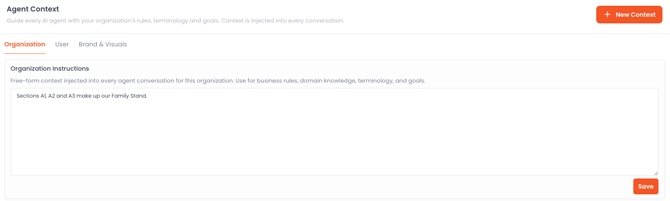
Organization-Level ContextOrganization Context should contain business knowledge that is relevant to everyone using the CDP.
The data might tell the AI that someone purchased product ST-FAM-01, for example. Organization Context can explain that this means a Family Season Ticket, which covers two adults and up to three children and should be treated differently from a regular season ticket.
Useful examples include:
- Stadium or arena capacity and section groupings
- Definitions of season tickets, memberships, VIP and hospitality products
- Important supporter personas or audience groups
- Business rules used for revenue and performance analysis
- Definitions of competitions, events or product categories
- Relationships and terminology across your data sources
- Current strategic priorities
This is particularly useful for segmentation and analytics, where understanding the business meaning behind a field can be just as important as having access to the field itself.
For example:
"Sections A1, A2 and A3 make up our Family Stand."
The AI can then consider this definition when you ask it to analyze family ticket sales or identify supporters for a family-focused campaign.
Different people use the same CDP for different purposes. User Context helps the AI understand what matters specifically to you.
This could include:
- Your preferred language
- Your role and business priorities
- Preferred revenue or attribution sources
- Data sources you commonly work with
- Reporting and communication preferences
- Campaign or segmentation priorities
- Instructions for how you prefer answers to be structured
A ticketing manager, for example, might primarily care about season ticket renewals and match-by-match revenue, while a CRM manager may focus on database growth, engagement and campaign conversion.
A simple rule is: if everyone in your organization should know it, use Organization Context. If it mainly describes how you work, use User Context.
Add Business Rules and Data KnowledgeAgent Context can also work as a simple business dictionary for your CDP.
For example:
"A lapsed season ticket holder is someone who had a season ticket last season but has not purchased one this season."
Or:
"When reporting ticket revenue, exclude complimentary tickets."
Adding definitions like these helps the AI interpret your data according to your actual business logic instead of making assumptions based only on field names.
This is especially valuable when your organization has terminology that would be obvious to your team, but not necessarily obvious from the underlying data.
Keep Temporary Context TemporaryContext can have an expiration date. Use this for information that is important now but should not influence the AI forever.
For example:
"Until September 30, our main commercial priority is selling the remaining season tickets."
Once that period has passed, the AI no longer needs to treat this as an active priority.
Brand & Visual Context
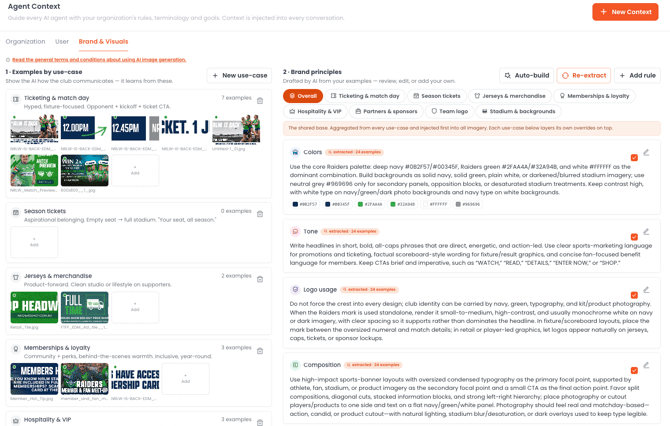
Under Admin → Agent Context → Brand & Visuals, you can also teach the AI how your organization should look and communicate.
This context can support AI-generated marketing content and visuals, helping outputs feel more consistent with your club or organization's identity.
Learn From Your Existing ContentThe CDP can analyze images from the last 12 months of your Content Library and identify recurring patterns such as:
- Brand colors and logos
- Visual style and composition
- Common layouts
- Tone of voice and copywriting principles
- Preferred terminology
- Branding do's and don'ts
- Different categories and styles of existing images
This gives the AI a practical starting point based on content your organization actually uses.
Define Your Own GuidelinesYou can also provide Brand & Visual Context directly. This is recommended when you already have established brand guidelines or rules that cannot reliably be understood from historical images alone.
For example, you might explain how the club crest should be positioned, which colors should dominate matchday graphics, what terminology should be avoided, or how sponsor branding should be handled.
The two approaches work together: the AI can learn from what you have created previously, while your team provides the rules behind those choices.
Best PracticesKeep Agent Context focused on information that adds meaning to your data and AI interactions, rather than repeating information already stored in the CDP.
Think about what a new colleague would need to know before they could correctly analyze your business, build audiences, or create campaigns. Those definitions, rules and priorities are usually the most valuable context to add.
The better the AI Marketing Department understands your organization, the less context you need to provide in every conversation and the more relevant its analysis, recommendations and content become.